
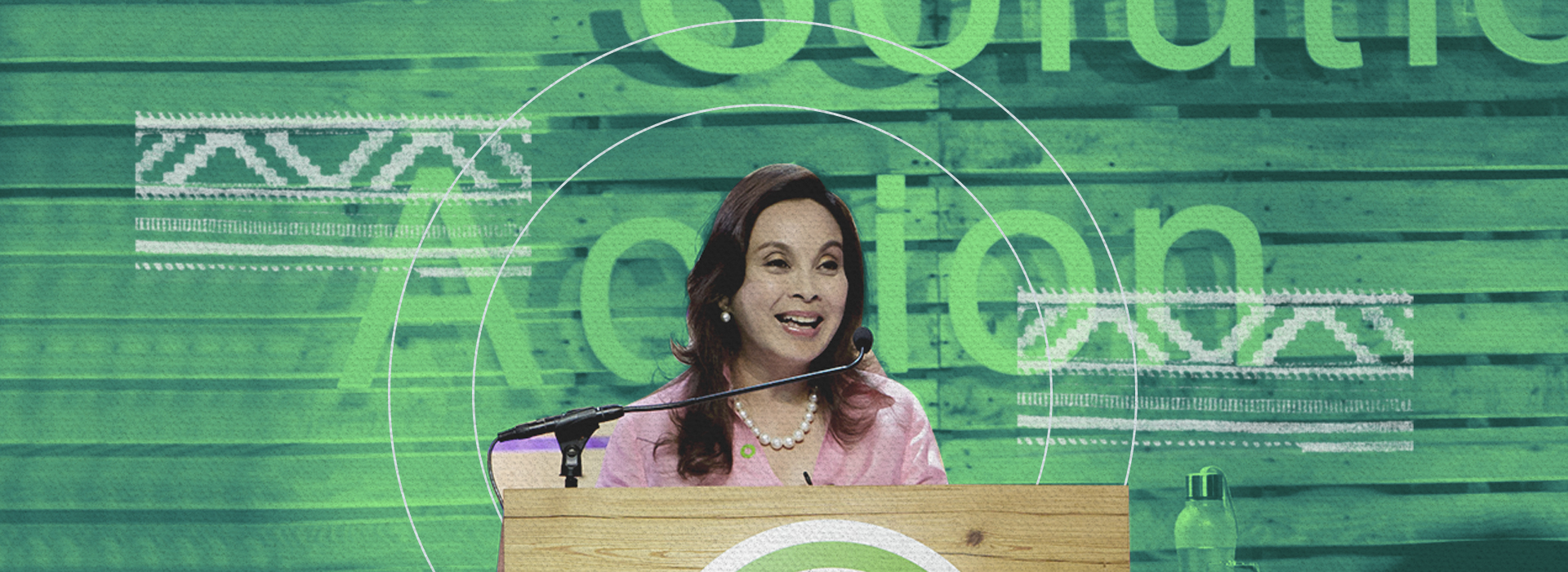
Legarda: Responsible and Integrity-driven budgeting means better lives for Filipino families
December 19, 2025Senator Loren Legarda emphasized the importance of responsible and integrity-driven budgeting as she joined her colleagues in finalizing the 2026 national budget during the Bicameral Conference Committee Meeting, highlighting that responsible planning and clear priorities lead to real benefits and improvements in the lives of Filipino families.
“As the Bicameral Conference Committee concludes its work on the 2026 national budget, I renew my strong support for proactive, well-planned budgeting that truly responds to the needs of our people,” Legarda said.
“Budgeting must come from a full year of honest computation, clear priorities, and genuine respect for taxpayers’ money. Kung ang pondo ay naaantala, minadali, at hindi pinag-isipan, taumbayan ang nahihirapan mula kalsadang hindi matapos-tapos, kulang na serbisyong pangkalusugan at edukasyon, mahinang paghahanda sa sakuna, kabuhayang hindi umuunlad, at mga programang napapako sa pangako,” she added.
Legarda commended Senate Finance Committee Chair Senator Sherwin “Win” Gatchalian for his leadership in steering the Senate’s budget deliberations, as well as the bicameral conferees from both the Senate and House for ensuring a people-centered, transparent, and efficient allocation of funds.
“I thank Senate Finance Chair, Senator Win Gatchalian, for his steady hand and fairness throughout the budget proceedings, and all our bicameral conferees for working tirelessly in the spirit of national interest. This effort has allowed us to craft a balanced budget that safeguards health, education, and livelihoods,” Legarda said.
Stronger safeguards in infrastructure spending
In response to public concerns on overpricing, weak project identification, and misuse of flood control funds, the Bicameral Conference Committee adopted a set of structural safeguards to make infrastructure spending more transparent, traceable, and accountable. No flood control project was included in the GAA.
A key safeguard is the strict requirement that infrastructure projects carry specific details, such as clear geographic coordinates, stationing, and identifiable locations, and, for local projects, supporting resolutions from concerned local government units. With these requirements, every road, bridge, building, and flood control structure can be traced and audited from approval to implementation, and communities will know exactly where projects are supposed to be built.
Cost integrity was another central focus. By requiring the application of revised Construction Materials Price Data (CMPD) across the Department of Public Works and Highway (DPWH) projects, material, logistics, and hauling costs were recalibrated to reflect actual market conditions on a project-by-project basis. This correction of systemic overpricing across more than 10,000 projects generated substantial savings while ensuring that legitimate projects remain implementable, workers’ jobs are protected, and contractor pricing is not arbitrarily distorted.
To further strengthen transparency, the bicameral committee required that all approved infrastructure projects, including any modifications or realignments, be uploaded to the transparency portals of both Houses of Congress, with major programs supported by digital dashboards showing project descriptions, coordinates, and implementation status. These tools will allow Congress, auditors, local officials, and citizens to monitor projects in near real time and reduce the risk of undocumented changes or post-approval substitutions.
The bicameral committee also restructured implementation authority so that sector-specific projects are handled by the most appropriate agencies, rather than being concentrated in one department. Selected construction and convergence programs previously implemented solely by DPWH were reassigned to agencies such as the Department of National Defense (DND), Department of Agriculture (DA), and Department of Education (DepEd). Infrastructure may now be implemented through national agencies, local government units, public–private partnerships, or hybrid arrangements, subject to accreditation and safeguards, to improve delivery and accountability on the ground.
Redirecting savings to health and safety nets
This year’s bicameral conference secured major budget victories by rationalizing CMPD of the DPWH, generating ₱20.773 billion in savings realigned to priority areas like health and disaster response. This included restoring PhilHealth’s full sin tax allocation by adding ₱16.5 billion to the ₱53.26 billion in the National Expenditure Program (NEP), ensuring stronger universal health coverage for every Filipino family.
Legarda was among the first to champion the restorations in the PhilHealth budget: the government’s ₱60 billion PhilHealth obligation per Supreme Court ruling, and the sin tax share increase. Also part of the DPWH savings, ₱4.2 billion for the National Disaster Risk Reduction and Management Fund was secured to bolster quick response capabilities in the face of typhoons, earthquakes, and other calamities.
“We’re not just restoring funds, we are putting the right funds in the right agencies. The ₱20.7 billion savings we secured from DPWH will go a long way in strengthening health services and disaster response, delivering real relief and protection to Filipino families when they need it most,” Legarda stressed.
Highest education budget in history
As Chairperson of the Senate Committee on Higher, Technical, and Vocational Education, Legarda highlighted that the 2026 education budget is the highest in history, with a total allocation of around ₱1.38 trillion, about 20 percent of the national budget and roughly 4.5 percent of Gross Domestic Product (GDP). She emphasized that this represents a concrete investment in free and quality education, from basic education to tertiary and technical-vocational training.
As part of this commitment, Legarda also championed a ₱850 million increase in the Educational Assistance Program of the Office of the Presidential Adviser on Peace, Reconciliation, and Unity (OPAPRU). This program grants ₱50,000 per learner per school year for decommissioned MILF and MNLF combatants, their family members, and eligible indigenous peoples, opening pathways to formal education and reinforcing the government’s socioeconomic commitments under the Normalization Track of the Comprehensive Agreement on the Bangsamoro (CAB).
The budget of the Department of Education (DepEd) increased from the House-approved ₱914.14 billion to ₱961.32 billion at the bicameral level. Measured against the President’s NEP, DepEd’s budget rose from ₱874.50 billion to ₱961.32 billion to support classroom construction and learning facilities, education digitalization and ICT connectivity, school-based services and equipment, and the overall delivery of basic education nationwide, particularly in high-demand and urbanized areas.
For higher education and skills development, Legarda emphasized that the 2026 budget strengthens free and accessible pathways to college and technical-vocational training. The Commission on Higher Education’s (CHED) budget grew from ₱43.57 billion to ₱47.40 billion, with this figure expected to increase further once the Tulong Dunong program is fully centralized under CHED with an allocation of ₱2.73 billion and additional realignments from state universities and colleges.
Legarda also noted that the decision to close the ₱12.3 billion cumulative deficiency in Free Higher Education allocations from 2022 to 2025, through ₱4.48 billion in direct appropriations and ₱7.82 billion from CHED’s Higher Education Development Fund, represents a major step forward and a strategic investment in the education of Filipino students.
This expanded funding will not just support the Universal Access to Quality Tertiary Education, but also medical scholarships, English language laboratories, ICT infrastructure, and office improvements that directly benefit students.
“For many families, the most important question is, magkakaroon ba ng pagkakataon ang mga anak natin para sa isang dekalidad at libreng edukasyon?” Legarda said. “This historic ₱1.38-trillion education budget means more classrooms built, more students in state universities studying tuition-free, and more TESDA scholars gaining skills that translate into real jobs. Hindi na ito pangako lang sa papel, kundi konkretong oportunidad para sa kinabukasan ng ating mga kabataan.”
The Technical Education and Skills Development Authority (TESDA) received ₱26.06 billion under the bicameral version to sustain skills training, technical-vocational education, and scholarship and certification programs such as STEP and TWSP, while maintaining flexibility to respond to actual workforce and industry needs. This ensures that out-of-school youth, workers seeking upskilling, and jobseekers have concrete opportunities to gain employable skills.
Empowering local governments and communities
Legarda also supported increasing the Local Government Support Fund (LGSF) to ensure that resources reach barangays, upland and indigenous communities, and small municipalities directly. “Budgeting is not just accounting. It is governance. It is ensuring that families have roads to travel on, jobs to depend on, and barangays equipped to serve their people,” she said.
“Responsible and integrity-driven budgeting is about farmers with passable roads, students with real opportunities in quality schools, workers with sustainable livelihoods, communities that feel secure, families protected from climate disasters, and barangays with the tools to serve their own people,” Legarda said.
“Ang pambansang budget ay hindi lang listahan ng proyekto, ito ang direksyon ng buhay ng bawat pamilyang Pilipino.”(30)