
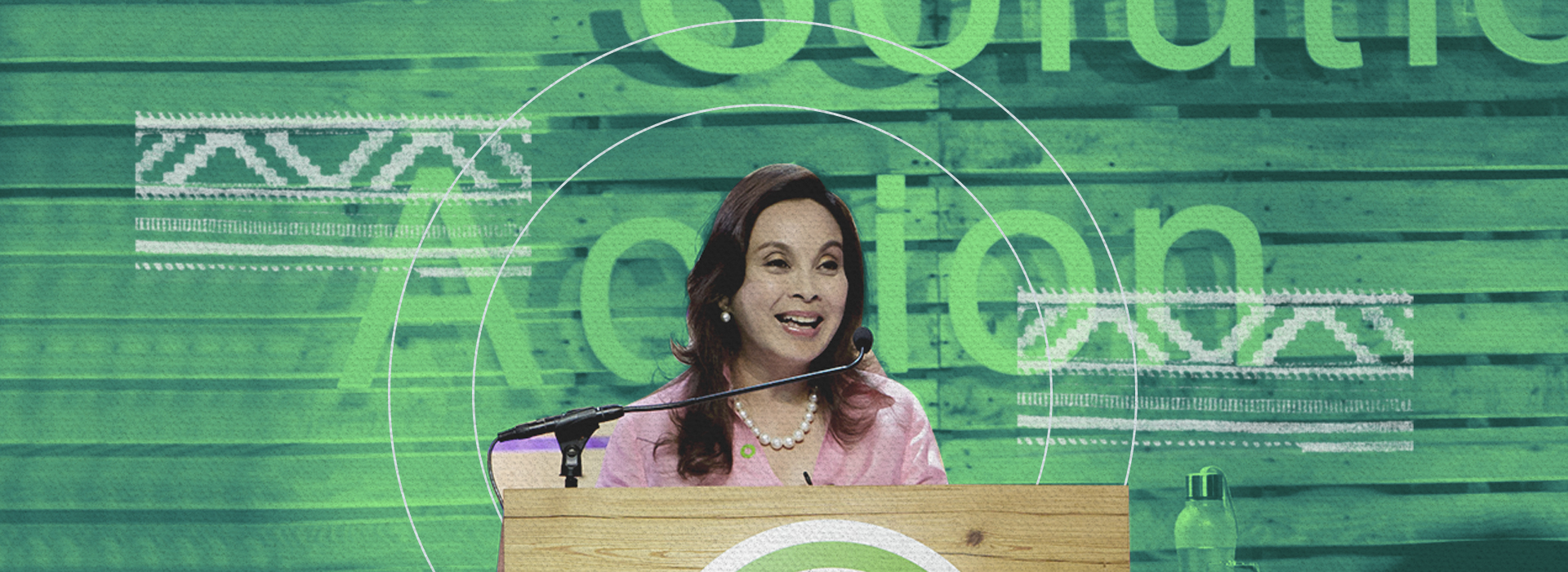
Legarda affirms backing of stronger law against online child exploitation
February 11, 2026Senator Loren Legarda affirmed her support for the Expanded Anti-Online Sexual Abuse or Exploitation of Children (OSAEC) and Anti-Child Sexual Abuse or Exploitation Materials (CSAEM) Act of 2025, a measure amending Republic Act No. 11930 to strengthen safeguards against evolving forms of child exploitation in digital spaces, as she delivered her co-sponsorship speech in plenary on February 10.
She recalled that even before she entered public service in 1998, she was already documenting the horrors of human trafficking through her investigative program “Inside Story.” As a young journalist, she produced a documentary on a book titled “They Are So Sweet, Sir,” which chronicled the lives of trafficked Filipinas in the Philippines and abroad in the 1970s and 1980s, showing that trafficking was already a global scourge even before the rise of today’s digital technologies.
“Long before I entered public service, I saw how syndicates prey on vulnerability and poverty, and how victims are silenced by fear, shame, and coercion,” Legarda said, recalling the stories of women and children lured by false promises only to be trapped by syndicates that thrive on secrecy, intimidation, and impunity.
“Through their stories, I learned that perpetrators do not stand still. They move with technology, hide behind new fronts, and exploit every gap in law, every weakness in coordination, and every moment of institutional delay,” she added.
Legarda stressed that when criminals become more creative, the State cannot remain static but must respond with stronger policies, smarter enforcement, and united action across agencies, communities, and borders.
“This is why I championed Republic Act 10364 or the Expanded Anti-Trafficking in Persons Act of 2012—to strengthen our laws, tighten accountability, and build a more coordinated national response against an evolving crime. Today, the same logic applies with even greater urgency to online child sexual abuse and exploitation,” Legarda exclaimed.
The four-term senator also pointed out that while Republic Act 11930 was a landmark legislation, abusers have quickly adapted to encrypted platforms, digital payment channels, and cross-border hosting services.
“The harm is no longer confined to a specific place; it is recorded, replicated, and traded, leaving a digital footprint that follows a child for life,” she said.
Legarda said the urgency of action is further underscored by reports that convicted American pedophile Jeffrey Epstein operated a network in the Philippines around 2010, when the country already had anti-trafficking laws in place. She mentioned that she will file a resolution calling on the Department of Justice, the National Bureau of Investigation, and the appropriate Senate committee to investigate Epstein’s footprint in the Philippines, including the organizations, syndicates, and public relations outfits that may have worked to cleanse his physical and digital image, stressing that anyone who enabled or profited from the abuse of children must be held accountable.
She stressed that confronting the full extent of this network, and the systems that allowed it to operate despite existing laws, requires not only investigations but stronger legal tools that close gaps in enforcement and cooperation.
The proposed amendments to RA 11930 aim to improve coordination among agencies, impose greater accountability on platforms operating in or reaching the Philippines, and equip authorities to secure and use digital evidence to identify victims, build cases, and collaborate with foreign partners. Legarda explained that the measure reinforces enforcement by setting firmer accountability standards and ensuring consistent child protection, moving away from fragmented efforts toward a more reliable system
“The Expanded Anti-Online OSAEC and CSAEM Act of 2025 is a necessary step in keeping our laws responsive to evolving technology and cross-border criminality. In supporting this measure, we affirm that the Philippines will not allow digital spaces, financial channels, or jurisdictional distance to become safe havens for those who profit from the abuse of children,” she concluded. (30)